BobNet
Not vibe coding. A team.
Rotating terms: team, system, network, circle of review
Behind my work there's no single chatbot, but me and my agent team: a network of specialised AI agents — with fixed roles, mutual checks and a human who carries the responsibility.
Act 1 · The problem
Written fast. Broken fast.
AI now generates code in minutes. Keep shouting wish after wish at it and you'll quickly get something that runs — until it doesn't. That's called vibe coding.
One chat for everything
A single assistant plans, writes, tests and judges its own work. Nobody pushes back.
No memory
When the chat ends, the knowledge ends. The next session starts from zero.
No brakes
Without guardrails, unreviewed code quickly ends up where it can do damage: in production.
Act 2 · One team per project
Every project gets its own team.
For every project I assemble a dedicated team of AI agents — structured like a good development department: a lead who plans and integrates, plus specialists with clearly scoped jobs. I call them Bobs, and they're at work every day.

Bob · Team lead
Slices work packages, briefs the team and is the only one who merges changes.

Henry · Design
Drafts and motion concepts — the blueprint for every interface.

Luke · Frontend
Builds the interfaces, tests first.

Bill · Backend
Data models, APIs and business logic.

Bridget · Content
Copy, translations and search-engine basics.

Riker · Code review
Checks every change for correctness and clean style.

Marvin · Tests
Is what's claimed actually true? Only green tests count.

Dexter · Privacy & security
Hunts for data leaks, secrets in code and licensing issues.

Loki · Live QA
Checks in a real browser whether it really works.

Bender · Release
Prepares deliveries and verifies them afterwards.

Homer · Documentation
Keeps architecture and interfaces written down.
One role per area, never two agents in the same code. Pushback is explicitly welcome. And memory lives in files — handovers, inbox, lessons — not in a fleeting chat.
Act 3 · Teams that work together
Many teams. One network.
Many teams work on my server, each on its own project. When one needs help from another area, it asks the responsible team directly — like departments that know each other. That's the BobNet.
Just ask
A team hits a problem in the shared delivery tooling. Instead of tinkering with it alone, it brings in the responsible team — together they update the tool, for every project.
Remote Bob · the server keeper
Not every team runs all the time. Remote Bob keeps the overview, starts the right team and mediates between them.
Inbox, not shouting
Teams write to each other through a shared inbox. Every request is traceable, every answer documented.
Everything visible
Every agent reports its status before each step. The BobNet dashboard shows live who's working on what.
Act 4 · The Circle of Trust
No code without a second review.
Rotating terms: a second review, tests, live proof, sign-off
The heart of it: every change passes several independent checks before it's merged. A single no from any checkpoint stops it.
A second model checks the first
Code written by one model is reviewed by another — including one from a different vendor: if an Anthropic model writes, an OpenAI model reviews, or the other way round. Different training, different blind spots.
Multiple gates
Code review, tests, privacy and security, live browser test: every gate can say no.
Evidence, not claims
Every report names the command that reproduces the result. “Green” without proof doesn't count.
Mistakes become rules
Every bug found is recorded as a lesson and feeds into the rulebook of every team.
Act 4 · Trust in tiers
Trust is tiered — and technically enforced.
The higher the risk, the more review. The most critical steps stay with the human — not just by agreement, but technically locked.
T1 · Copy, translations, docs
Agents work independently, review checks along.
T2 · Features
Agent plus review, tests and a pre-release check.
T3 · Security, migrations, dependencies
The full Circle of Trust, including privacy and security review.
T4 · Production, credentials, DNS
Human only. Technically locked for every agent.
Act 5 · Proof
Not made up. In use.
The BobNet isn't a slide — it's how I work every day.
This website
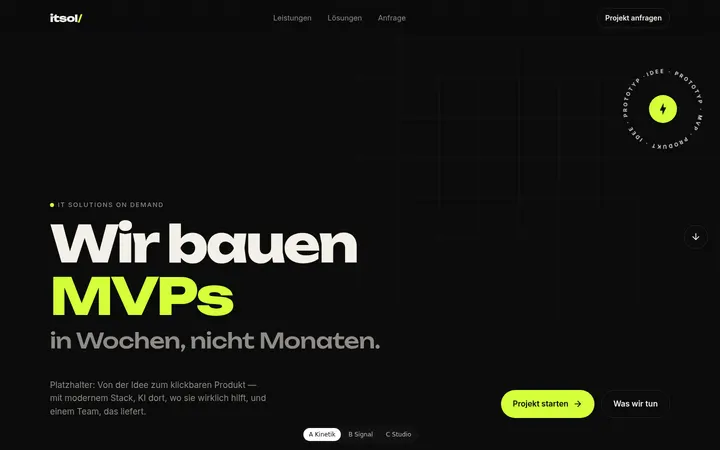
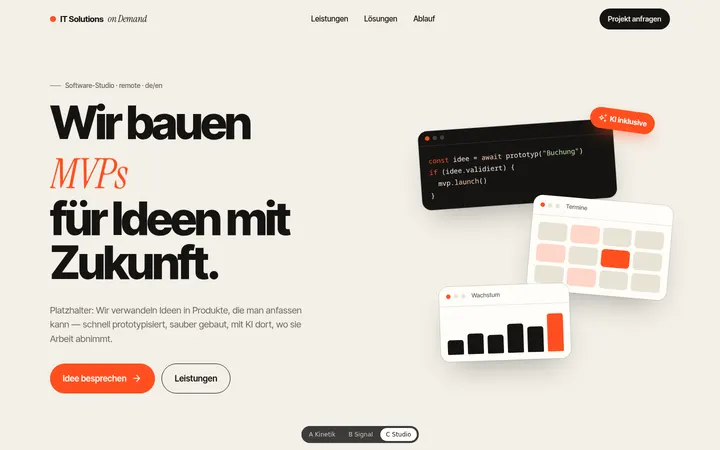
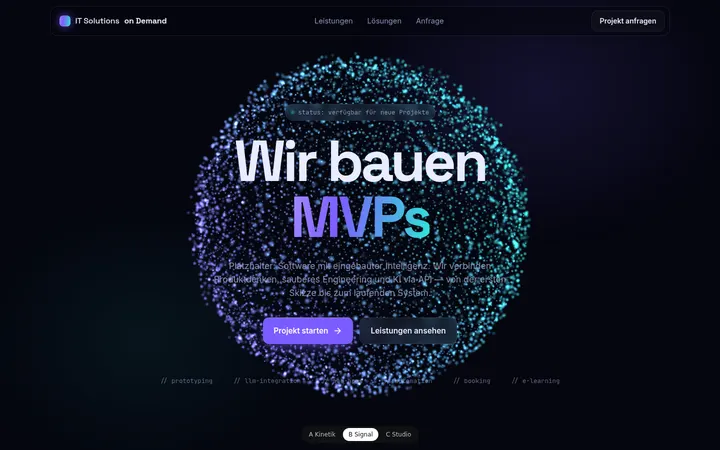
Team started — by the next morning, three fully worked-out design directions were on the table. One of them became the page you're reading.
KeyHub
Key management with digital handovers for a trades business. Built autonomously by AI agents, with architecture and sign-off by me — and running in production. The client is now taking the agent team in-house.
ValidSlots & ValidLearn
Two products of my own, built in parallel by my agent teams in about four weeks each: tested, documented, compliance-minded. ValidSlots: 2,300+ backend assertions and 858 frontend specs. ValidLearn: 630+ automated tests, 0 open security findings.
Real bugs caught
A reviewer from a different vendor found critical bugs the internal review had waved through. The live browser test spotted an access token in the console that no unit test could see. And the production lock even stopped my own team lead — exactly what it's there for.
Act 5 · Timeline
From the first chat to the BobNet.
How a single session became a network of teams — in just a few weeks.
21 May 2026
First session with Claude Code
The beginning: one chat, one project — and the quick realisation that a single assistant isn't enough.
23 May 2026
BobNet 1.0
Three days later the first team framework stands: fixed roles, shared rules. Still closed, internal on GitLab.
29 May 2026
Feature request to Anthropic
A public field report to Anthropic on what agent teams need — stable naming and a live stand-up.
github.com (opens in a new tab)31 May 2026
The Bobiverse
Single teams become a network: every project with its own team, all on the same engine.
3 June 2026
BobNet 2.0 — open source
The engine goes public: claude-bobnet on GitHub, under the MIT licence. Public since June 2026, currently at version 0.19.
- 2 July Model and reasoning depth per role
- 17 July Watchdog with urgency levels and escalation
15 June 2026
Idea: cluster Bobiverse
The next thought: not just teams on one server, but a network spanning several servers.
Late June 2026
“The Logbook” on trendgegner.com
Writing down what I learned along the way.
As of one month of Claude Code and three weeks of BobNet.
- 19 June Loops are for noobs
- 20 June Company 2028
18 July 2026
BobNet 3.0 — in progress
A rebuilt core: every agent runs as its own process in its own session. A central broker checks every start, locks agents to approved directories and logs every attempt without gaps. Several AI vendors run behind the same interface.
github.com (opens in a new tab)
Act 6 · Any language
I deliver in Ruby.
Rotating terms: Ruby, TypeScript, Python, Rust, Swift, Kotlin
Because quality comes from my review system rather than from my own habits alone, I'm not tied to any programming language. You get the language that fits your problem — not the one I happen to know best.
Rewrite, don't patch
Rebuild an existing project in a faster, safer language — quickly and properly reviewed. Or ship an app for every platform in a short time.
The foundation
That only works with clean code and strict review. That's why the Circle of Trust stands at the start of every project, not at the end.
What does this mean for you?
Your project. Your team.
You get the speed of an AI team and the care of reviewed engineering — with a human who stands behind the result.
I build for you
A dedicated agent team for your project, led by me. You see the progress, take part in decisions and give the sign-off.
Your own team
Want to keep developing yourself? I set up an agent team for you and hand it over — just like with KeyHub.
AI handles the routine. Responsibility stays human.
Tell me what you want to build. I'll show you what a team for it would look like.
Start a projectCredits
- Team lead
- Bob
- Design
- Henry
- Frontend
- Luke
- Content
- Bridget
- Second review
- OpenAI reviews Anthropic — and vice versa